
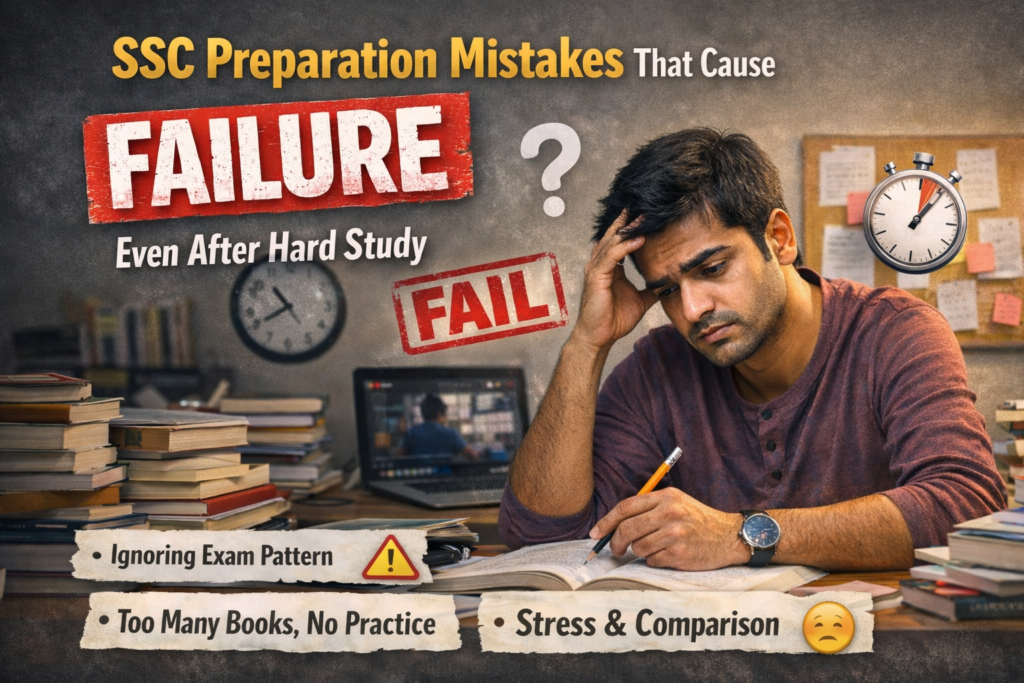
Every year, lakhs of aspirants appear for SSC exams such as SSC CGL, CHSL, MTS, GD Constable, and CPO with full dedication and high hopes. Many of them study for 8–10 hours daily, solve multiple books cover to cover, follow popular YouTube teachers, and attempt dozens of mock tests.
For complete preparation, visit our SSC Exams page.
Yet, the harsh reality remains unchanged — only a small percentage finally clear the exam.
If you are someone who is working extremely hard but still failing, missing cut-off by a few marks, or stuck at the same score, the problem is not your intelligence or effort.
In most cases, the real reason is critical mistakes in SSC preparation strategy — mistakes that look harmless but silently destroy results.
This article explains the most common yet dangerous SSC preparation mistakes that cause failure even after months or years of sincere hard work. These are not beginner mistakes — these are mistakes made by serious, hardworking aspirants.
This guide is especially useful for:
• First-time SSC aspirants
• Repeat candidates stuck below cut-off
• Working aspirants with limited daily study time
If you identify and correct even 3–4 mistakes from this list, your selection probability can improve drastically.
Upcoming bank exams expected dates 2026: Complete list
—
1. Studying Without Understanding the SSC Exam Pattern
One of the most underestimated mistakes is starting SSC preparation without deeply understanding the exam pattern.
Many aspirants:
• Start reading books immediately
• Follow random YouTube teachers
• Solve questions blindly
Keep “completing syllabus” as the only goal
Why this causes failure
SSC exams are pattern-based, not syllabus-based.
If you do not clearly understand:
• Tier structure (Tier-1, Tier-2, Skill Test)
• Section-wise weightage
• Time pressure per section
• Impact of negative marking
you will end up spending maximum time on low-return topics while ignoring high-scoring, repeatedly asked areas.
What selected candidates do differently
Before opening any book, they:
• Analyze last 5–7 years SSC PYQs
Identify:
• Frequently repeated topics
• Sections that decide cut-off
Areas where most candidates lose marks
👉 SSC rewards strategy, not blind hard work.
—
2. Ignoring Previous Year Questions (PYQs)
Many aspirants confidently say:
> “I’ll do PYQs later. First I want to complete the syllabus.”
This single mindset is responsible for thousands of SSC failures every year.
Why PYQs matter the most in SSC
60–70% of SSC questions are direct or pattern-based repeats
PYQs reveal:
• Real difficulty level
• Important concepts
• SSC’s favorite traps
• Actual question framing
How ignoring PYQs leads to failure
• You study many topics that rarely appear
• You misunderstand SSC logic
• Mock test scores remain stagnant
• Confidence drops despite hard study
Correct approach
• Start PYQs from Day 1
After every topic:
Solve 10–15 years of PYQs
Treat PYQs as:
Primary study material, not revision material
👉 If you master PYQs, half the battle is already won.
—
3. Over-Studying One Subject and Neglecting Others
Almost every aspirant has a comfort zone:
• Maths lovers ignore English
• English lovers fear Maths
• Reasoning is taken lightly
• GK is postponed endlessly
Why this ruins SSC selection
SSC selection depends on overall score, not mastery of one subject.
Example:
Maths: 45/50 ✅
GK: 15/50 ❌
Result: Fail
The dangerous mindset
> “I’ll focus on weak subjects later.”
The truth is — later almost never comes.
Balanced preparation strategy
• Study at least 3 subjects daily
Even weak subjects:
• Solve 10–15 questions daily
Gradual exposure removes fear
👉 SSC rewards balanced performance, not perfection.
—
4. Watching Too Many YouTube Videos but Solving Few Questions
Free content is helpful — but overconsumption is dangerous.
Common mistake
• Watching 6–7 hours of lectures
• Feeling productive
• Solving very few questions
Why this causes failure
SSC is application-based, not theory-based.
Watching videos:
• Creates false confidence
• Feels like learning
• Does not improve speed or accuracy
The golden rule
> 70% practice + 30% learning
For every:
1 hour of video, solve
50–70 quality questions
👉 If you only watch and don’t practice, your preparation remains incomplete.
—
5. Not Practicing Under Time Pressure
Many aspirants practice:
• Without a timer
• Slowly
• Comfortably
This habit is extremely dangerous.
Reality of SSC exam
• 100 questions
• 60 minutes
• High competition
• Very small margin for error
Why untimed practice fails
• Concepts are known but not applied fast
• Panic during real exam
• Many questions remain unattempted
Correct method
Use a timer from early stages:
• Maths: ~1 min/question
• Reasoning: 30–40 sec
• English: ~30 sec
👉 Speed must be trained, not expected.
—
6. Giving Mock Tests Without Proper Analysis
• Mock tests alone do not improve marks.
Many aspirants:
• Attempt mock
• Check score
• Feel demotivated
• Move to the next mock
Why this causes repeated failure
Improvement comes from analysis, not attempts.
Without analysis:
• Same mistakes repeat
• Weak areas remain weak
• Scores stagnate
Correct mock strategy
After every mock:
Spend 2–3 hours analyzing
Identify:
• Wrong questions (why wrong?)
• Unattempted questions (why skipped?)
• Time-consuming questions
Maintaining a mistake notebook is a powerful habit of selected candidates.
—
7. Running After Too Many Books and Resources
• Resource overload is a silent killer.
Typical behavior
• 3 Maths books
• 2 English books
• 5 YouTube teachers
• Multiple test series
Why this leads to failure
• No depth in any resource
• Constant confusion
• No consistency
Golden rule
> One subject = One book + One PYQ source
Master limited resources:
• Revise multiple times
Solve completely
👉 SSC rewards clarity and repetition, not quantity.
—
8. Ignoring Revision (The Silent Killer)
Many aspirants:
• Study new topics daily
• Rarely revise
Why revision is critical
• SSC questions are tricky
• Forgotten formulas cause silly mistakes
• Accuracy drops without revision
Common excuse
> “I don’t have time to revise.”
Truth:
> You don’t have time not to revise.
Simple revision system
• Daily: Revise previous day (15–20 min)
• Weekly: Revise weak areas
• Monthly: Full subject revision
Without revision, hard study does not convert into marks.
—
9. Emotional Stress, Comparison & Inconsistency
Mental mistakes are as dangerous as academic ones.
Common psychological traps
• Comparing with toppers
• Checking others’ mock scores
• Feeling “I’m behind”
• Losing consistency
Why this causes failure
• Breaks momentum
• Reduces confidence
• Leads to burnout
Healthy mindset
Compete with your past self
Focus on:
• Daily improvement
• Weakness correction
👉 SSC is a marathon, not a sprint.
—
10. Preparing Without a Realistic Daily Plan
Many aspirants have:
• Big goals
No daily structure
Result
Random study
Skipped topics
Guilt and stress
Correct approach
Create a simple daily plan:
Fixed study hours
Subject-wise slots
Practice + revision included
Even 3–4 focused hours daily are better than 10 unplanned hours.
—
Final Words: Hard Work Fails Only When Direction Is Wrong
If you are studying hard but not seeing results, do not quit.
Most SSC failures happen not due to lack of effort, but due to avoidable strategic mistakes.
Remember:
SSC does not require genius
SSC requires:
Smart strategy
PYQ-based preparation
Consistency
Calm mindset
Correct these mistakes, and your hard work will start showing results.
—
Frequently Asked Questions (FAQs)
Q1. Can average students clear SSC exams?
Yes. SSC selection depends on strategy, not intelligence.
Q2. Is coaching necessary for SSC preparation?
No. Many SSC toppers cleared the exam without coaching using PYQs and mock analysis.
Q3. How many hours are enough for SSC preparation?
3–6 focused hours daily with proper planning are sufficient.
—
📌 If this article helped you:
Share it with a fellow SSC aspirant
Bookmark it for revision
Correct one mistake at a time
—